

Atlas Client Hub: From Project Knowledge to working code.
A developer needed a tenant-scoped client directory in an existing multi-tenant app, without weakening tenant isolation. ARGV turned the project’s recorded knowledge into a scoped Task Pack, Codex implemented it through the ARGV CLI, and the result was checked separately in the running local app.
A local demonstration, not a customer project or production deployment. ARGV recorded the run as succeeded · unverified; the checks on this page were run separately. Read the evidence and limits
Atlas Client Hub, start to finish 1:26
A silent, captioned edit of original ARGV screens, a condensed CLI transcript and live clips of the local Atlas app.
Silent video. Everything shown is captioned on screen and summarized here.
What the video shows
- Title
- Eight Project Knowledge entries recorded before the task
- The selected Skill: Implement tenant isolation
- Task Pack R2, with a note on its accidental approval
- The seven-step workflow plan
- One Execution queued, then claimed by the ARGV CLI running Codex
- Excerpt from the original CLI transcript
- Live local Atlas: sign-in, creating a client, listing it after reload
- A duplicate external reference rejected within the tenant
- Checks run separately from ARGV
- ARGV’s own outcome: succeeded · unverified
- What the demonstration does not show
New to ARGV? Watch the 90-second introduction
- Starting point
- Existing Next.js, .NET 10 API and PostgreSQL starter
- ARGV context
- 8 Project Knowledge entries · 1 Skill
- Task Pack
- R2 · seven-step plan · 13 success criteria
- Execution
- ARGV CLI with Codex · 4 min 37 s
- Code changes
- 4 files modified · 8 created
- Independent checks
- 15/15 .NET · 9/9 UI · 15/15 live API
01 · Challenge
Add a client directory without weakening tenant isolation.
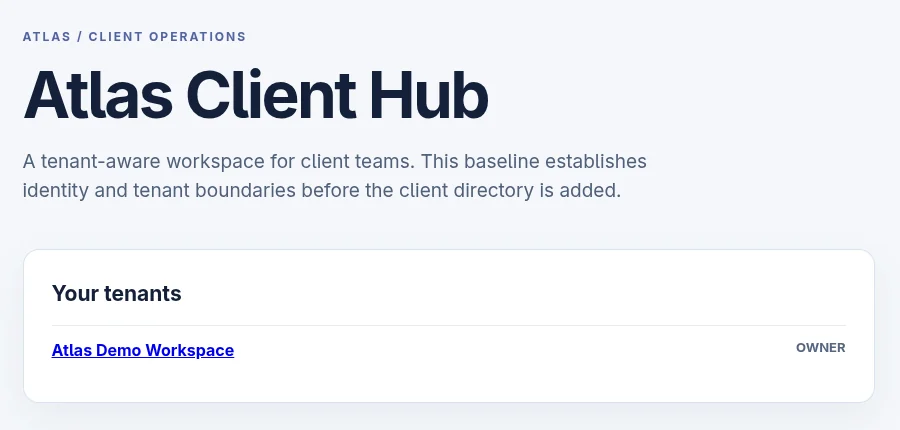
Atlas Client Hub is a founder-built demonstration app: a tenant-aware workspace for client teams. It already had a starter architecture before any ARGV work. A Next.js App Router front end with a server-side BFF, an ASP.NET Core .NET 10 API that owns the OIDC cookie session, and tenant memberships in PostgreSQL. That baseline was committed and verified before ARGV was involved.
The task was its first client-directory slice. Signed-in users list and create clients within a tenant. Owner, Admin and Member may create; Viewer may only read. No second authentication authority, no browser database access, and no way to see or change another tenant’s data.
02 · Knowledge & Skill
What the project already knew.
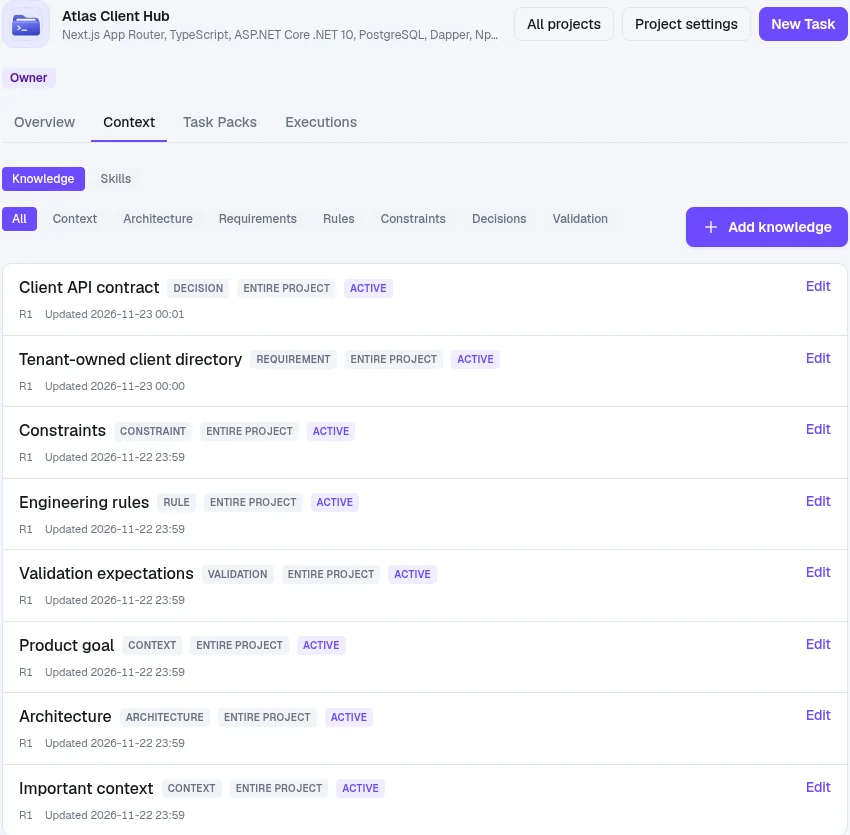
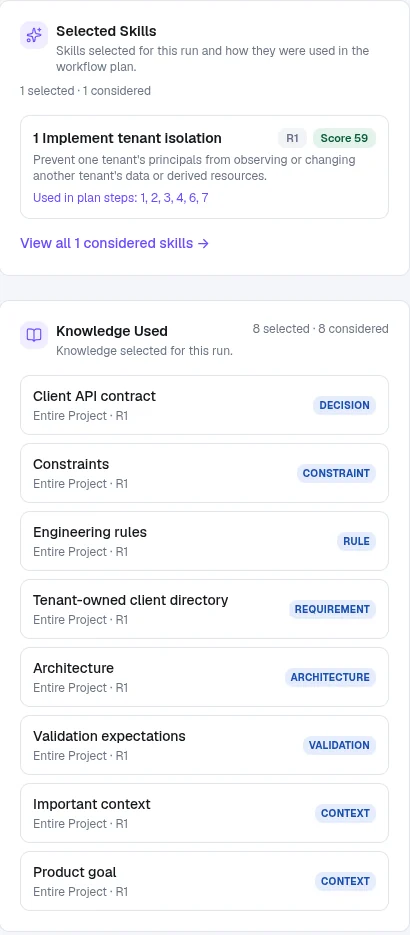
Before the task, eight typed Project Knowledge entries were recorded in ARGV, each at revision R1. One Skill, Implement tenant isolation, was imported from ARGV’s Skill catalog. ARGV selected all eight entries and the Skill for the run.
- Architecture: Next.js handles presentation and a server-side BFF; the .NET API owns sessions, authorization and versioned /api/v1 contracts; PostgreSQL is reached only through the API.
- Client API contract (decision): a paged GET and a POST under /api/v1/tenants/{tenantId}/clients. The route’s tenant is the requested scope, never the authority.
- Engineering rules: every tenant-owned row carries tenant_id; inaccessible records return the same 404 as missing ones; Viewer reads only.
- Constraints: no EF Core, Prisma, second auth authority, client-side secrets or direct browser database access.
- Also recorded: the client-directory requirement, validation expectations, the product goal and important context.
03 · Task Pack R2
A scoped specification, refined once.
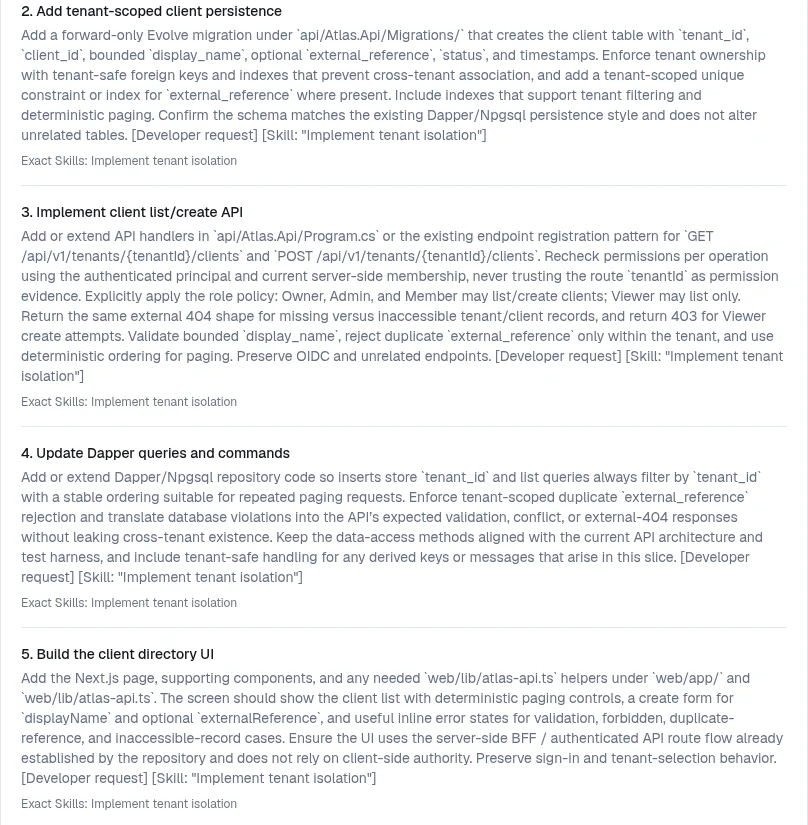
The first generation produced Task Pack R1. One targeted refinement produced R2, using ARGV’s Engineering Contract v1, with the same eight Knowledge entries and Skill. R2 carries a seven-step workflow plan, 13 success criteria and explicit scope: list and create only, with detail, update, contacts and billing left for later.
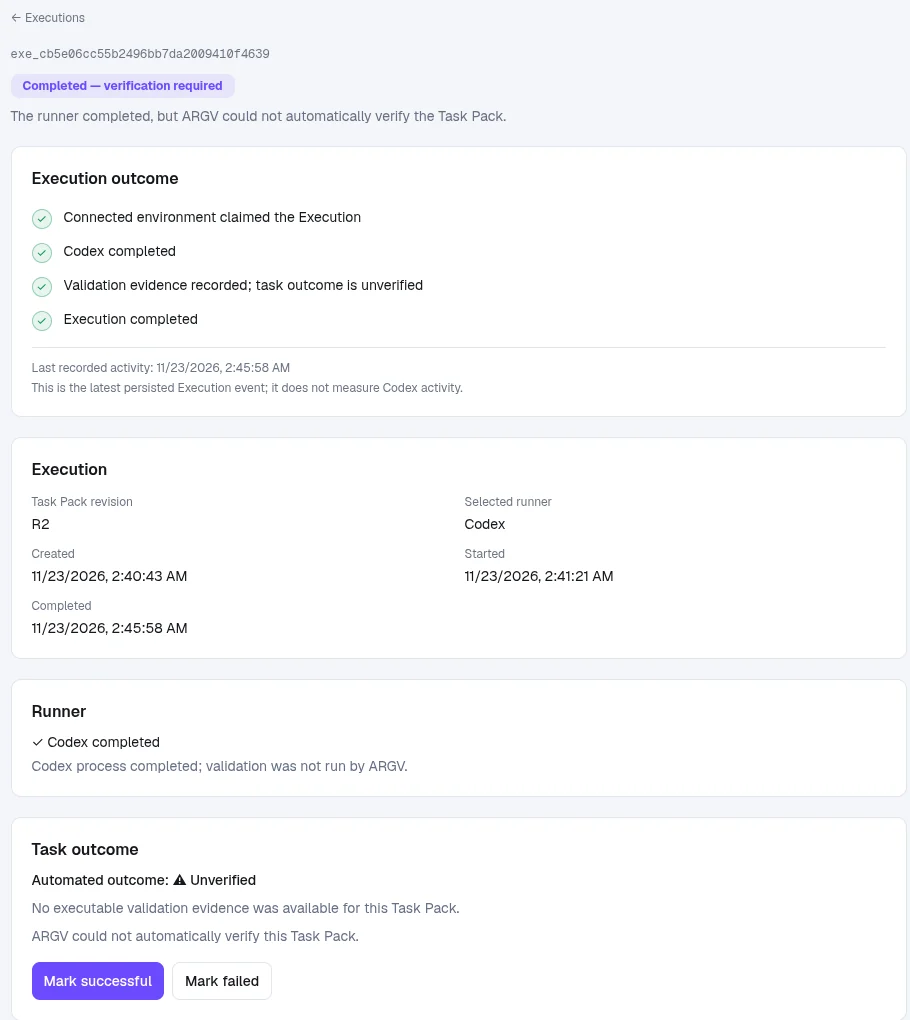
R2 contained no executable validation rules. That is why ARGV could not verify the result automatically later.
## Objective
Implement the first tenant-scoped client-directory slice in the separate Atlas starter
repository so signed-in users can list and create clients with server-enforced tenant
isolation, deterministic pagination, role-aware authorization, and a small Next.js UI that
surfaces success and error states correctly.

## Success criteria (3 of 13)
- Owner, Admin, and Member may list and create clients; Viewer may list only.
- Cross-tenant read and write attempts return the same external 404 shape as missing records.
- Duplicate `external_reference` values are rejected only within the same tenant.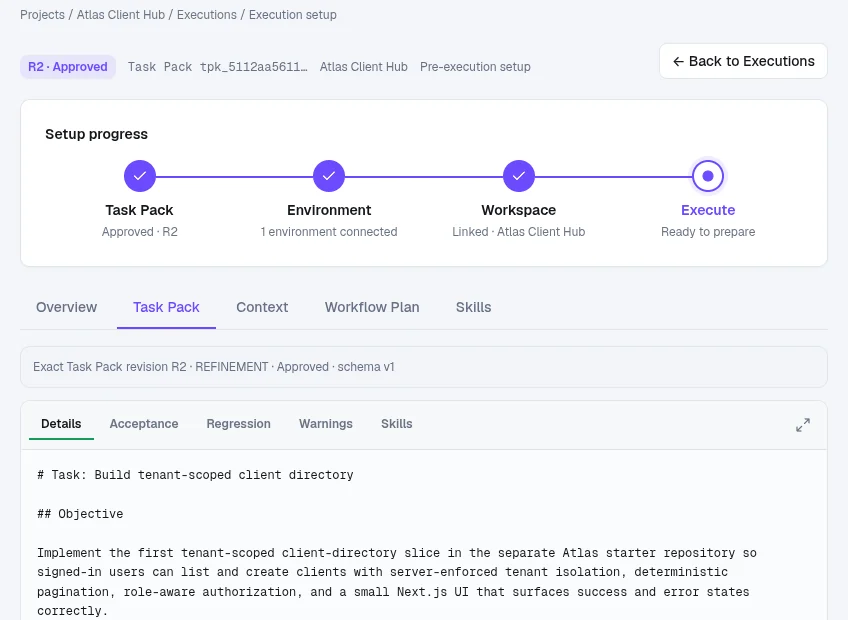
04 · CLI & Codex execution
One Execution, handed to the developer’s own machine.
After a preflight check, the developer separately authorized a single Execution of R2. It was queued in ARGV. The ARGV CLI, connected to the Atlas repository on the developer’s machine, claimed it, confirmed the workspace binding and a clean baseline, and ran Codex.
Codex worked for 4 minutes 37 seconds, modified 4 files and created 8. Its own attempt to run the .NET tests was blocked by its sandbox, so it reported those tests as unverified.
✓ Execution claimed exe_cb5e06cc…
  Build tenant-scoped client directory
✓ Workspace binding verified
✓ Repository verified
  HEAD       5e0873158ec5
  State      clean
✓ Codex turn completed
  4 modified · 8 created · 0 deleted
  Duration   4m 37s
⚠ No executable validation rules configured
⚠ Execution succeeded · Unverified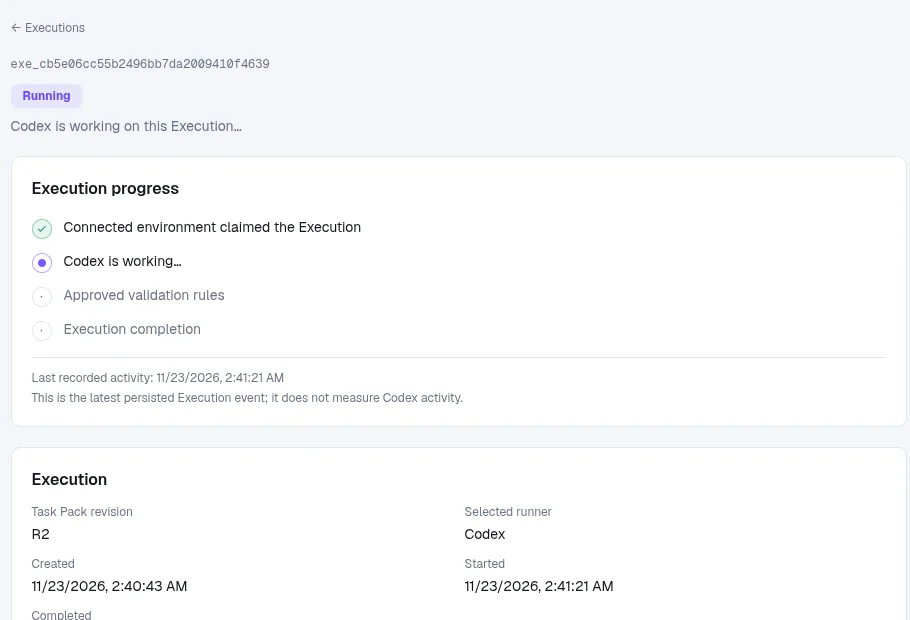
05 · Result
A working client directory in the local app.
The change stayed inside the existing boundary: browser, Next.js server BFF, .NET API, PostgreSQL. It introduced no new authentication authority, no ORM and no browser database access.
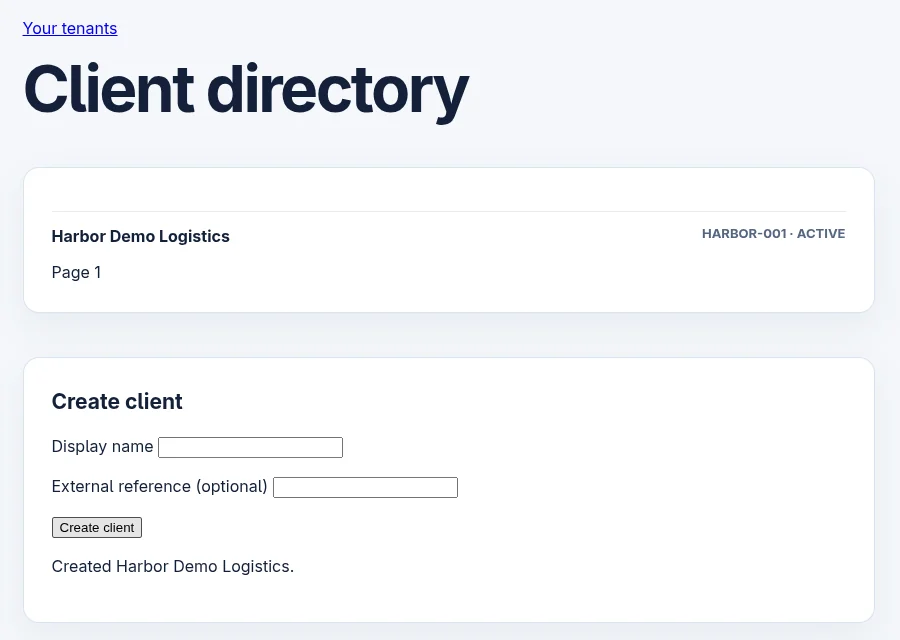
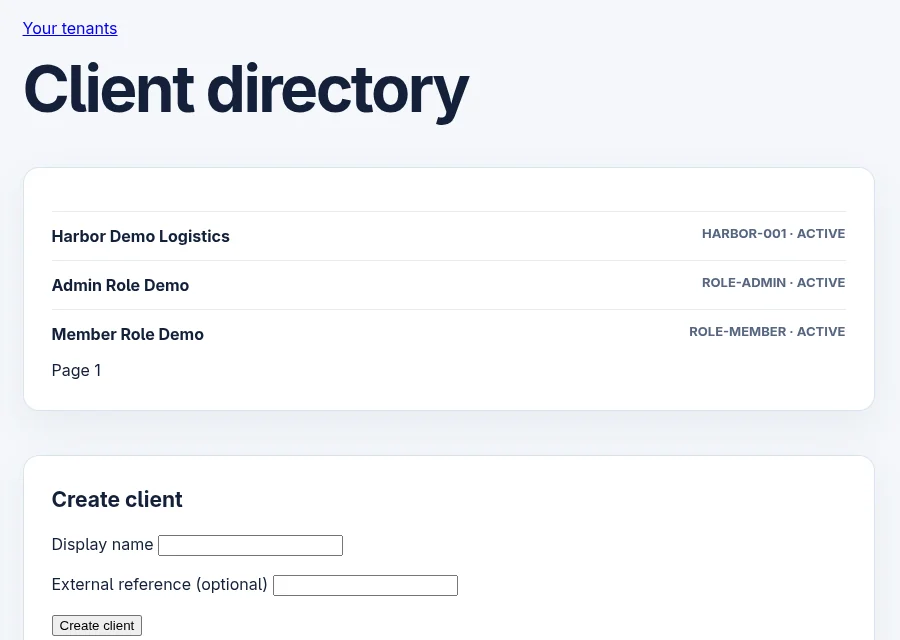
After the migration was applied to the local demo database, a browser signed into Atlas through a real Google OIDC flow created a client through the form, listed it after a reload, and showed a duplicate reference being rejected.
- A V002 migration adds atlas.clients with a (tenant_id, client_id) primary key, a tenant foreign key, a tenant-scoped unique index on the external reference and a tenant-prefixed paging index.
- Dapper/Npgsql persistence for tenant-filtered inserts and deterministic paged lists.
- List and create API routes that recheck the caller’s current tenant membership and role before any SQL.
- A Next.js client-directory page and form with clear validation, forbidden and duplicate-reference errors.
- Eight new API integration cases, nine UI/helper tests and a document mapping how tenant identity is enforced.
06 · Verification & limits
What was checked, and what was not.
ARGV recorded the Execution as completed but could not verify it: its outcome is succeeded · unverified. Every check below was run separately from ARGV and is not ARGV’s automatic validation.
| Check | Result | How it was checked |
|---|---|---|
| ARGV Execution outcome | Succeeded · unverified | R2 had no executable validation rules, so ARGV did not validate the change. |
| .NET tests | 15 / 15 passed | Including eight new client-directory cases against a disposable PostgreSQL instance. |
| UI and helper tests | 9 / 9 passed | Rendered states with mocked API responses, not browser end-to-end. |
| TypeScript and Next.js build | Passed | Run after the Execution. |
| Live browser | Passed | Real Google OIDC sign-in; create, list after reload, and the duplicate error (captured on a focused retry). |
| Live API checks | 15 / 15 passed | Anonymous 401, Viewer create 403, cross-tenant read and write 404 identical to a missing tenant, blank name 400, duplicate 409, Admin and Member create 201. |
| PostgreSQL isolation | Passed | Demo tenant held 3 rows, a separate tenant 1. Denied, invalid, duplicate and anonymous writes created none. |
| Migration | Applied once | V002 on the local demo database only, recorded in migration history; keys and indexes checked. |
Limits and caveats
- Local demonstration only. Atlas ran on the developer’s machine. Nothing was deployed and no production readiness is claimed.
- Task Pack R2 was approved by accident: a broad automation selector clicked “Approve R2” during a recording. That approval was not treated as permission to run. The developer separately authorized the single Execution after a preflight check.
- ARGV’s own outcome was succeeded · unverified. The tests and checks on this page were run independently of ARGV.
- Role checks used one real Google OIDC identity whose local Atlas role was changed in a controlled fixture (Viewer, Admin, Member) and then restored to Owner. They did not use four separate accounts.
- The effective Codex model and the Execution’s monetary cost were not recorded.
- Codex’s own .NET test run was blocked by its sandbox. The passing run was a separate, correctly configured run outside the agent.
- The first automated browser capture marked the duplicate check as failed because of a timing race; a focused retry captured the actual error. Both records are kept.
Deeper evidence
The technical walkthrough.
For readers who want the detail: the longer original edit, with the plan, the implementation path and the live permission checks.
Technical walkthrough 3:31
The original technical evidence edit from 23 November 2026, published unchanged: plan detail, implementation path, database and test gates, and the live permission checks.
Unedited since recording: screenshot text is small and development-mode overlays are visible.
What the video shows
- Introduction
- Selected Skill and eight Knowledge entries
- Task Pack R2
- The seven-step plan in detail
- Execution queued and running
- Original CLI/Codex transcript summary
- Implementation path: browser to Next.js BFF to .NET API to PostgreSQL
- Database and test gates
- Live Atlas: sign-in, create and list
- Live permission and isolation checks
- Duplicate reference error and ARGV outcome
- Evidence and limits
Prepare work your coding agents can follow.
Start with a Free Trial: a personal workspace and 10 ARGV-sponsored generations to prepare Task Packs for the coding agent you already use.